

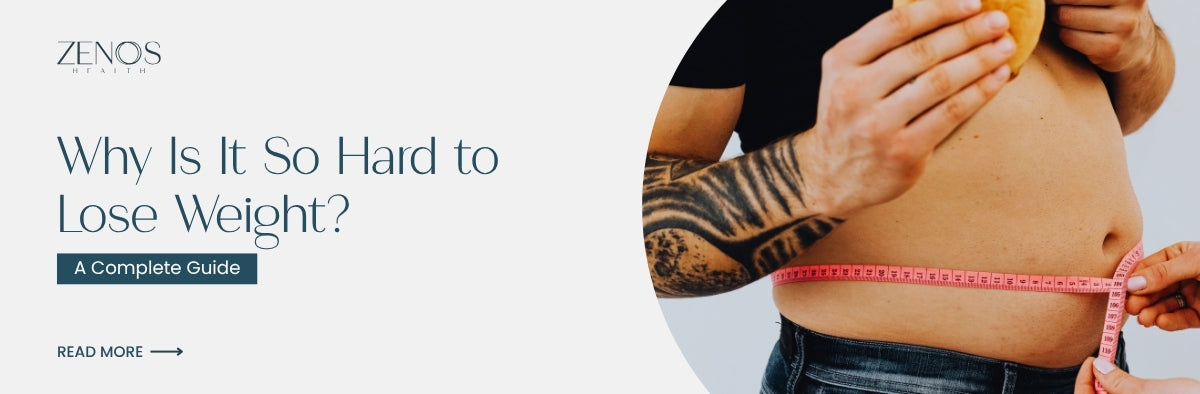

If you are struggling to lose weight, the problem is almost certainly not willpower. Your body has biological defense systems that actively resist weight loss.
When you lose weight, your metabolism slows disproportionately, a response researchers call metabolic adaptation. Your body burns fewer calories than predicted for your new size. (1, 2)
Weight loss triggers lasting hormonal changes: ghrelin (your hunger hormone) increases while leptin (your satiety hormone) decreases, making you feel hungrier for months or even years after losing weight. (3, 4)
Understanding why weight loss is so hard is the first step toward a strategy that works with your biology instead of against it.
Targeted nutritional support for glucose metabolism, appetite regulation, and thermogenesis can help address some of the biological barriers to sustained weight loss.
You have tried the calorie counting. You have done the workouts. You have had stretches where things seemed to be working, only to watch the scale stall or creep back up. And at some point, you have probably asked yourself: why is it so hard to lose weight?
That question deserves an honest answer, and the honest answer is this: losing weight is hard because your body is designed to make it hard. Not because you are doing something wrong. Not because you lack discipline. Because your biology has a sophisticated set of defense mechanisms that interpret weight loss as a threat and actively work to reverse it.
This is not a motivational speech. It is a science-backed explanation of what is actually happening inside your body when you try to lose weight, and what you can do to work with these systems rather than be defeated by them.
To understand why losing weight is so difficult, you need to understand that your body does not want to lose weight. From an evolutionary perspective, your body’s primary job is survival, and stored body fat is an energy reserve that your biology interprets as essential for survival. When you create a calorie deficit, your body does not simply burn fat quietly. It fights back through at least four measurable mechanisms.
This is called metabolic adaptation (sometimes referred to as adaptive thermogenesis). When you lose weight, your resting metabolic rate (the calories your body burns at rest) drops. That is expected, because a smaller body needs less energy. But research shows the drop is often greater than what your new body size alone would predict. (1)
Martínez-Gómez and Roberts (2022) reviewed the evidence and confirmed that metabolic adaptation is a real phenomenon that plays a significant role in weight loss plateaus. Your body essentially becomes more fuel-efficient, burning fewer calories per pound than it did before you started dieting. (1)
A separate study by Martins et al. (2021) found that metabolic adaptation at the level of resting metabolic rate was associated with less weight and fat mass loss in individuals following low-energy diets. (2) In practical terms: the longer and harder you diet, the more your metabolism resists your efforts.
This is perhaps the cruelest part of why weight loss is so hard. When you lose weight, your body changes the hormones that control hunger and fullness, making you feel hungrier even after you have eaten.
Sumithran et al. (2011), published in the New England Journal of Medicine, enrolled 50 overweight or obese patients in a 10-week weight loss program. After losing an average of 13.5 kg, participants showed significant hormonal changes: ghrelin (the hormone that triggers hunger) increased, while leptin (the hormone that signals fullness), peptide YY, cholecystokinin, and insulin all decreased. (3)
The most striking finding: these hormonal changes persisted one full year after the initial weight loss. (3) Your body was still sending stronger hunger signals 12 months later, even though the diet was long over. This is why so many people struggling to lose weight feel like their appetite is working against them. It literally is.
Leptin is produced by fat cells and is supposed to tell your brain that you have enough energy stored and do not need to eat more. In theory, people with more body fat produce more leptin, which should suppress appetite. (4)
In practice, many people with excess body fat develop what researchers call leptin resistance: their brain stops responding to leptin’s fullness signal despite high circulating levels. (4) Think of it like a fire alarm that has been going off so long that everyone stopped paying attention. The signal is there, but the response is blunted.
This means your brain may be interpreting your body as “underfed” even when your fat stores are adequate, driving increased appetite and reduced energy expenditure simultaneously.
Biology is not the only reason why losing weight is so difficult. Your eating patterns are deeply embedded in your daily routines, emotional responses, social habits, and food environment. Stress eating, sleep deprivation, and living in an environment with constant access to calorie-dense foods all compound the biological challenges.
This is not a character flaw. It is the predictable result of a modern food environment that your ancient biology was never designed to navigate.
If you have ever been struggling to lose weight and watched progress stall despite maintaining the same diet and exercise routine, you have experienced a plateau. Plateaus are a direct result of the metabolic adaptation described above.
When you first create a calorie deficit, your body draws on stored energy and you lose weight. Over time, as your body adapts by lowering your metabolic rate and increasing hunger hormones, the same calorie deficit that produced results in week one is no longer sufficient by week eight or twelve. (1, 2)
This is frustrating, but it is not failure. It is your biology recalibrating. Strategies to move through plateaus include adjusting calorie intake downward, incorporating planned refeeds (temporary increases in calories to signal to your body that you are not starving), increasing non-exercise activity, and supporting your metabolism with targeted nutritional interventions.
Women face additional biological hurdles that make losing weight particularly challenging. These include:
Hormonal fluctuations. Estrogen and progesterone cycles affect water retention, appetite, cravings, and energy expenditure throughout the menstrual cycle. Weight can fluctuate by 1 to 3 kg across a single cycle, masking actual fat loss on the scale.
Lower baseline metabolic rate. Women generally have less lean muscle mass than men, which means a lower resting metabolic rate and fewer calories burned at rest.
Thyroid sensitivity. Women are significantly more likely than men to experience thyroid dysfunction, which directly impacts metabolic rate.
Perimenopause and menopause. Declining estrogen levels shift fat distribution toward the abdomen, reduce metabolic rate further, and can amplify insulin resistance.
If you are a woman wondering why losing weight is so difficult despite doing everything right, these factors may explain the gap between your effort and your results.
Understanding why weight loss is so hard does not make it easy, but it does help you choose strategies that address the actual barriers instead of fighting them blindly.
Prioritize protein. Protein increases satiety, has a higher thermic effect (your body burns more calories digesting it), and helps preserve lean muscle mass during a deficit, which partially offsets metabolic adaptation. (1)
Lift weights. Resistance training maintains or builds muscle mass, supporting your metabolic rate during weight loss. This is one of the most effective tools against the metabolic slowdown.
Use moderate, sustainable calorie deficits. Aggressive calorie restriction triggers stronger metabolic adaptation and hormonal resistance. Gradual rates of weight loss are associated with greater fat loss and better preservation of resting metabolic rate. (1)
Consider planned diet breaks. Periodic increases in calorie intake (1 to 2 weeks at maintenance) may help partially reverse metabolic adaptation and reduce psychological fatigue from prolonged dieting. (1)
Prioritize sleep. Sleep deprivation increases ghrelin, decreases leptin, impairs glucose metabolism, and reduces willpower. Seven to nine hours per night is a legitimate weight loss strategy, not a luxury.
Support glucose metabolism and appetite regulation. Targeted nutritional compounds can address some of the metabolic and hormonal barriers to weight loss. Ingredients like chromium, ceylon cinnamon, and green tea extract support glucose optimization and thermogenesis, addressing the metabolic side of the equation. This is the approach reflected in clinically formulated products like BurnZen from Zenos Health.
BurnZen was formulated to address the biological barriers that make weight loss so hard. Rather than stimulant-based appetite suppression, BurnZen targets multiple metabolic pathways:
Thermogenesis and calorie burn: CaloriBurn GP® (40 mg) and MitoBurn® (250 mg) support your body’s ability to convert stored energy into heat, helping offset the metabolic slowdown that accompanies dieting.
Glucose optimization: GlucoVantage® (300 mg), Ceylon Cinnamon (500 mg), and Chromium (200 mcg) support healthy blood sugar regulation. Stable glucose levels reduce the energy crashes and cravings that derail diets.
Appetite and satiety support: Saffron (100 mg) has been studied for its effects on appetite regulation and mood, addressing both the hormonal and emotional drivers of overeating.
AMPK activation: Actiponin® (450 mg) activates AMPK (adenosine monophosphate-activated protein kinase), a cellular energy sensor that promotes fat oxidation and supports metabolic efficiency.
Microbiome support: BPL1® Postbiotic (1B CFU) supports a healthy gut microbiota, which emerging research links to metabolic health and body composition.
Mood and well-being: aXivite® (62.5 mg), a capsaicin-based compound, and Saffron support mood during caloric restriction, when irritability and low motivation are common.
Browse the Body Composition collection for complete metabolic support. For gut barrier health, which plays a role in inflammation and metabolic regulation.





Leave a comment
Comments will be approved before showing up.