

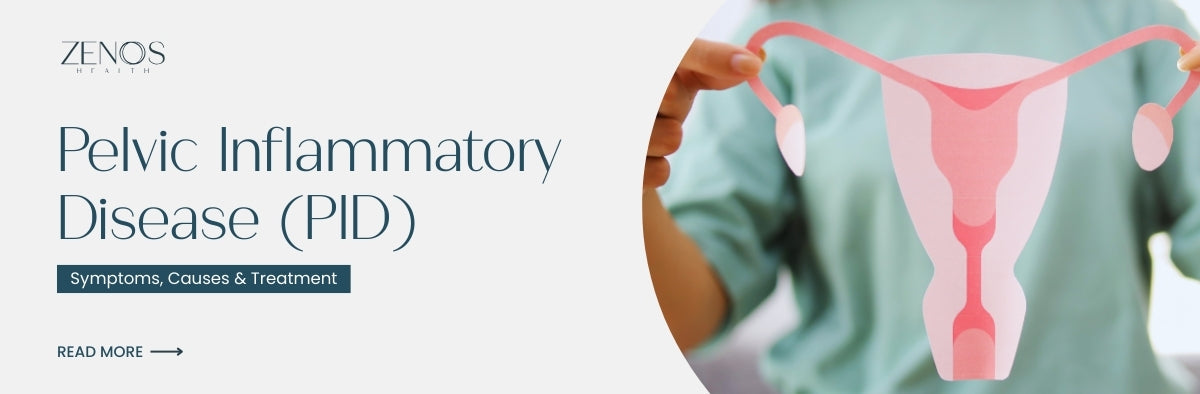

That dull ache in your lower abdomen. A vaginal discharge that seems heavier or differently colored than usual. Pain during sex, you have been quietly dismissing. These are not random inconveniences. For many women, the first signs of pelvic inflammatory disease (PID) are an infection of the upper female reproductive tract that affects more than 1 million women in the United States every year. [1]
What makes PID dangerous is its silence. A significant proportion of cases produce no noticeable symptoms at all, progressing undetected until complications emerge. Clinical research demonstrates that delayed treatment directly increases the risk of infertility and ectopic pregnancy. If any of the symptoms below sound familiar, this is what you need to know.
PID is an infection of the uterus, fallopian tubes, and ovaries. It occurs when bacteria ascend from the vagina or cervix into the upper reproductive tract, triggering inflammation that can cause permanent tissue damage if not treated promptly. Systematic reviews indicate that approximately 4.4% of sexually experienced women aged 18-44 in the United States have received a PID diagnosis in their lifetime. [1]
The majority of cases are caused by sexually transmitted bacteria, primarily Chlamydia trachomatis and Neisseria gonorrhoeae (gonorrhea), ascending from the cervix. [2] Both infections are frequently asymptomatic, making routine STI screening the most effective prevention strategy available. Additional causes include:
Bacterial vaginosis (BV): Disruption of the vaginal microbiome allows pathogenic bacteria to ascend more easily into the upper tract. Supporting vaginal flora balance with a targeted formulation like VZen is a clinically rational first line of defense.
Douching: Strips protective Lactobacillus colonies and pushes bacteria upward. Clinical guidelines consistently advise against it.
IUD insertion: PID risk is elevated in the first few weeks after insertion if an undetected STI is present.
Endogenous vaginal bacteria: In some cases, bacteria naturally present in the vagina can ascend without an STI trigger.
Symptoms range from undetectable to acutely disabling. The most common include:
Lower abdominal or pelvic pain: Dull, constant, and often bilateral. Typically worsens during intercourse or after menstruation.
Abnormal vaginal discharge: Heavier than usual, discolored (yellow, green, or gray), and often carrying an unusual odor.
Irregular menstrual bleeding: Spotting between periods or bleeding after sex.
Pain during sex (dyspareunia): Deep pelvic pain during or after intercourse.
Fever and chills: Temperature above 38.3°C (101°F) in acute cases.
Painful urination: Burning on urination, sometimes confused with a UTI.
There is no single definitive test for PID. Diagnosis is primarily clinical: CDC guidelines recommend initiating treatment in any sexually active woman with pelvic pain if cervical motion tenderness, uterine tenderness, or adnexal tenderness is present on pelvic examination. [2] Additional diagnostic tools include vaginal swabs, STI testing, transvaginal ultrasound, and, in uncertain cases, laparoscopy.
Treatment requires prompt antibiotics. The standard outpatient regimen combines ceftriaxone IM, doxycycline, and metronidazole over 14 days to cover the primary pathogens. [2] Sexual partners from the preceding 60 days must also be tested and treated. Human studies show that delaying treatment by three or more days after symptom onset is associated with a threefold increase in infertility and ectopic pregnancy risk. [3]
Even with timely treatment, PID carries a significant long-term risk. The PEACH trial found that after three years, approximately 18% of participants experienced infertility and 29% experienced chronic pelvic pain. [4] Infertility risk compounds with each episode:
After one episode, approximately 12% of women develop tubal ligation.
After two episodes, more than one-third of women are affected
After three or more episodes, approximately 50% of women are affected
Ectopic pregnancy is also significantly more likely after PID, occurring more than six times more often in women with a PID history compared to those without. [5]
Broad-spectrum antibiotics clear the infection but also disrupt the vaginal and gut microbiome, stripping the protective Lactobacillus colonies that maintain acidic pH and suppress pathogen regrowth. Research suggests that restoring healthy microbial populations after treatment supports a faster return to protective vaginal pH and reduces recurrence risk.
This is the rationale behind VZen from Zenos Health, a female health formulation targeting the gut-vaginal-urinary axis (the biological connection between gut microbiome health and vaginal and urinary tract function) with a combination of probiotics, prebiotics, and cranberry extract.
|
Ingredient |
Dose |
Clinical Role |
|---|---|---|
|
PaCran® Cranberry |
250 mg |
Supplies proanthocyanidins (PACs) that inhibit bacterial adherence to urinary and vaginal epithelial cells |
|
Probiotic Blend |
4 Billion CFU |
4 billion CFU total probiotic dose supporting competitive exclusion of pathogenic bacteria and restoration of beneficial microbial populations |
|
DE111® (Bacillus subtilis) |
50 mg |
Spore-forming probiotic strain with demonstrated gastric survivability, supporting gut microbiome integrity and digestive health |
|
PreforPro® |
15 mg |
Precision prebiotic that selectively feeds beneficial bacteria without feeding pathogens, supporting microbiome recovery after antibiotic exposure |
Give your microbiome the clinical foundation it needs. Explore VZen and browse the complete Female Health collection at Zenos Health.
Regular STI screening: Annual chlamydia and gonorrhea testing for all sexually active women under 25 is the single most impactful preventive intervention.
Consistent condom use: Barrier contraception is the most effective method for preventing STI transmission.
Avoid douching: Douching disrupts protective vaginal flora and independently elevates PID risk.
Treat BV promptly: Early treatment restores vaginal pH and reduces the risk of ascending polymicrobial infection.
Support the vaginal microbiome: Maintaining a resilient, Lactobacillus-dominant vaginal environment reduces vulnerability to both BV and ascending infection. VZen combines PaCran®, DE111®, and PreforPro® to support the gut-vaginal-urinary axis daily.
Partner treatment: Ensuring partners are tested and treated prevents reinfection and recurrent PID episodes.






Leave a comment
Comments will be approved before showing up.