

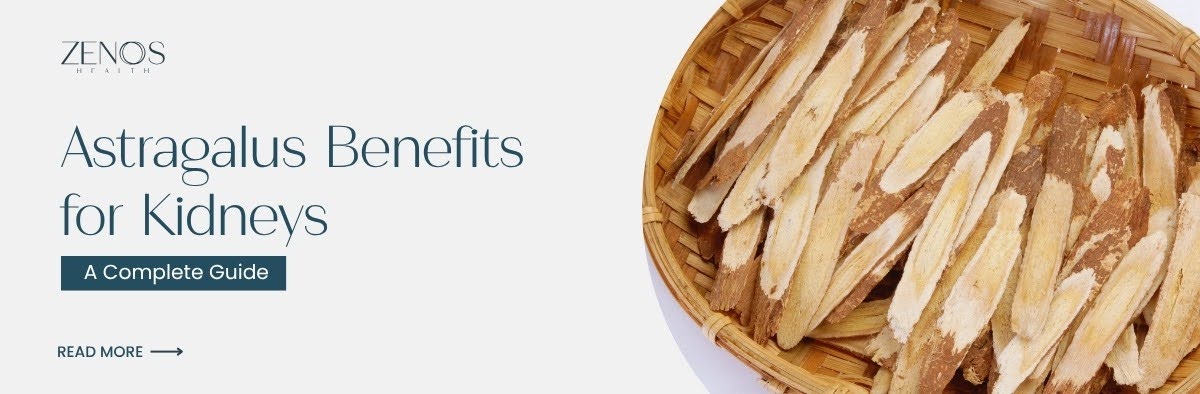

Astragalus membranaceus has been used in traditional medicine for centuries to strengthen kidney function. What separates it from most herbal remedies is that modern clinical research is now catching up to those traditional claims with real data from randomized controlled trials and meta-analyses.
For anyone wondering if astragalus is good for the kidneys, the short answer is that the clinical evidence is genuinely promising. Multiple human studies have demonstrated that astragalus-based supplementation can slow the decline of kidney function, reduce inflammatory markers, and protect kidney tissue from the scarring that leads to chronic kidney disease progression. Here is a closer look at what the research says, how astragalus works at the cellular level, and what to look for in a supplement.

The astragalus kidney benefits are not limited to a single mechanism. The herb contains bioactive compounds, primarily astragalosides (saponins) and polysaccharides, that act on multiple pathways involved in kidney health.
Your kidneys are among the most metabolically active organs in your body, filtering roughly 200 liters of blood daily. That constant workload generates significant oxidative stress, which is the accumulation of reactive oxygen species (free radicals) that damage cells and tissue. Over time, unchecked oxidative stress degrades the kidney's filtering units and accelerates functional decline.
Astragaloside IV, the primary active saponin in astragalus, has demonstrated strong antioxidant effects in kidney tissue. A 2024 study published in Frontiers in Pharmacology found that astragaloside IV reduced oxidative damage in kidney cells by suppressing the production of reactive oxygen species and protecting the cellular structures that maintain filtration capacity [1].
Chronic low-grade inflammation is one of the central drivers of kidney disease progression. When kidney tissue is inflamed, it triggers a cascade of damage that can lead to scarring and permanent functional loss.
Astragalus targets the NF-kB inflammatory pathway, one of the primary signaling routes your body uses to activate inflammation. Research shows that astragaloside IV suppresses the expression of pro-inflammatory genes in kidney tissue, reducing the inflammatory load on already-stressed kidneys [1][2]. For people with conditions like diabetes or high blood pressure, where kidney inflammation is a constant threat, this anti-inflammatory activity is especially relevant.
Fibrosis, the progressive scarring of functional kidney tissue, is what ultimately drives chronic kidney disease toward kidney failure. Once healthy tissue is replaced by scar tissue, it cannot regenerate or perform its filtering function.
Astragaloside IV has been shown to inhibit the TGF-Beta/Smad signaling pathway, the key driver of fibrosis in kidney tissue. A 2024 study confirmed that astragaloside IV reduced kidney fibrosis by blocking the transformation of healthy kidney cells into scar-producing cells, a process called epithelial-mesenchymal transition [2]. Slowing or preventing this transformation is one of the most important ways to preserve long-term kidney function.

Preclinical evidence is strong, but the real question is whether astragalus benefits for the kidneys hold up in human studies. Several recent clinical trials offer compelling answers.
A 2024 multi-center, randomized controlled trial published in Phytomedicine tested astragalus-based supplementation in patients with type 2 diabetes and chronic kidney disease. Over 48 weeks, patients receiving astragalus alongside standard care showed a significantly slower rate of kidney function decline, measured at 4.6 ml/min/1.73m2 per year, less than the standard care group [3]. The study also reported reductions in fasting glucose and markers of kidney damage.
A 2025 prospective clinical study published in the International Journal of Medical Sciences followed 75 patients with stage 3 to 5 chronic kidney disease who received an astragalus-based formulation for six months alongside conventional medications. Median estimated glomerular filtration rate (eGFR), the standard measure of kidney function, improved significantly from 34.37 to 42.47 ml/min/1.73m2 [4]. Cell culture analysis from the same study confirmed that astragalus compounds protected kidney tubular cells and inhibited fibrosis-related proteins.
A 2023 meta-analysis published in Medicine reviewed 50 randomized controlled trials involving 3,423 patients with kidney conditions. The analysis found that astragalus-based formulations, when combined with standard treatment, produced significantly better outcomes than standard treatment alone, including higher complete and partial response rates and improved markers of kidney function [5].
Population-level data is also encouraging. Registry studies tracking CKD patients who used astragalus-based formulations found an overall reduced rate of kidney function decline (3.2 ml/min/1.73m2 per year), a 59% reduced hazard of kidney failure, and a 66% reduced hazard of mortality [3].

Astragalus for the kidneys is worth considering for several groups:
Adults over 40, when age-related kidney function decline typically accelerates
People with type 2 diabetes, since elevated blood sugar is a primary driver of kidney damage
Those with high blood pressure, another leading cause of chronic kidney disease
Anyone with a family history of kidney disease who wants to take a proactive approach
People taking medications that place additional strain on the kidneys, including long-term NSAID use
Astragalus supplementation is not a replacement for medical treatment of diagnosed kidney conditions. However, as the clinical evidence shows, it can complement standard care and support kidney function preservation, particularly when started before advanced disease stages.
Not all astragalus supplements are formulated for kidney health. When choosing a product, consider these factors:
Standardization to astragalosides: the active saponins responsible for most of astragalus's kidney-protective effects. Supplements should specify the astragaloside concentration rather than listing raw herb powder.
Clinically relevant dosing: the human trials cited above used meaningful doses of standardized astragalus extract. Check that a product delivers an adequate amount per serving.
Complementary kidney-supportive compounds: astragalus works best as part of a multi-pathway approach that also addresses oxidative stress, urinary tract defense, and fluid balance.
Zenos UriZen includes Astragalus membranaceus Extract (750 mg, standardized to 0.5% Astragalosides) alongside Alpha Lipoic Acid (750 mg) for antioxidant kidney protection, Cranberry Extract (500 mg, 30% Proanthocyanidins) for urinary tract defense, and AstraGin® (50 mg) for enhanced nutrient absorption. The formulation addresses multiple pathways that contribute to kidney health rather than relying on astragalus alone.
Astragalus is no longer just a traditional remedy with historical claims. Multi-center randomized controlled trials, prospective clinical studies, and meta-analyses of thousands of patients have demonstrated measurable kidney health benefits, from slowing functional decline to improving eGFR to reducing fibrosis markers.
Zenos UriZen delivers a clinically relevant dose of standardized astragalus alongside complementary compounds designed for comprehensive kidney and bladder support. If protecting your kidney function is a priority, give your body the targeted nutritional support the research supports.







Leave a comment
Comments will be approved before showing up.