

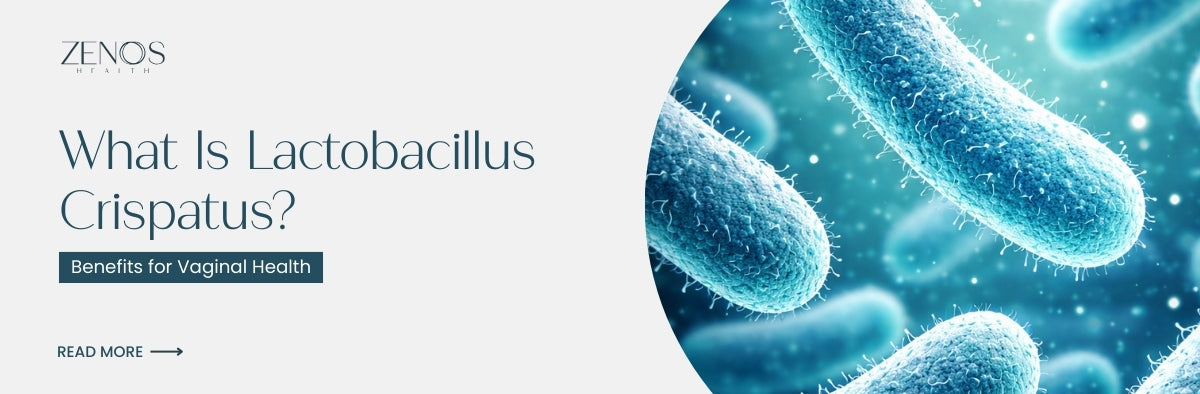

Lactobacillus crispatus is the dominant protective bacterium in a healthy vaginal microbiome, producing lactic acid to maintain optimal pH between 3.8-4.5
Clinical research shows women with L. crispatus-dominated vaginal flora have significantly lower rates of bacterial vaginosis (BV), UTIs, and yeast infections
L. crispatus protects through three mechanisms: acidification, competitive exclusion (physically blocking pathogens), and antimicrobial compound production
Supporting strains like L. gasseri and L. rhamnosus work alongside L. crispatus in the vaginal ecosystem
Antibiotics, hormonal changes, and lifestyle factors can disrupt L. crispatus populations, increasing infection risk
Recurring vaginal infections, persistent discomfort, and that frustrating cycle of antibiotics followed by another flare-up. If this pattern sounds familiar, understanding your vaginal microbiome may hold the answer. At the center of vaginal health sits one particularly important bacterium: Lactobacillus crispatus. This probiotic strain has emerged from decades of research as the primary guardian of vaginal wellness, and science is finally explaining why some women experience recurring infections while others maintain lasting balance.
Lactobacillus crispatus belongs to the Lactobacillus species family, a group of beneficial bacteria you may recognize from probiotic supplement labels. The name comes from their defining characteristic: producing lactic acid (lacto = milk, bacillus = rod-shaped bacteria). These microorganisms are responsible for fermentation in foods like yogurt, sauerkraut, and kimchi.
While various Lactobacillus species live throughout your body, including the gut and mouth, L. crispatus has specifically evolved to thrive in the vaginal environment. Unlike other strains that may temporarily visit or colonize, L. crispatus makes the vaginal tract its permanent home, creating the most effective protective barrier possible.
Lactobacillus acidophilus: The gut health champion found in most general probiotic supplements
L. gasseri: Found in the intestines and the lower reproductive tract; supports immune function and vaginal health
L. rhamnosus: Versatile strain studied for both gut and vaginal health applications
L. jensenii: Produces lactic acid and supports vaginal defense through multiple mechanisms
Lactobacillus crispatus: The primary vaginal health specialist with the strongest research for infection prevention
Lactobacillus crispatus operates like a three-layer security system, each mechanism reinforcing the others:
Layer 1: Acidification. L. crispatus produces lactic acid, maintaining vaginal pH between 3.8-4.5.1,2 This acidic environment is inhospitable to harmful bacteria and yeast. Research demonstrates that lactic acid at physiological concentrations mediates a 106-fold decrease in BV-associated bacteria viability while not affecting Lactobacillus species.1 Pathogens like Gardnerella vaginalis (associated with BV) and Candida albicans (causing yeast infections) cannot thrive in properly acidified conditions.
Layer 2: Competitive Exclusion. Through a process scientists call competitive exclusion, L. crispatus physically adheres to vaginal epithelial cells (the lining of the vagina). By occupying available space on vaginal tissue, it literally crowds out harmful microorganisms before they can establish colonies. Think of beneficial bacteria taking up all the parking spaces so pathogens have nowhere to go.
Layer 3: Antimicrobial Production. Beyond lactic acid, L. crispatus produces additional antimicrobial compounds, including bacteriocins. While some early research focused on hydrogen peroxide production, more recent studies show that under the low-oxygen conditions of the vaginal environment, lactobacilli produce little to no H₂O₂, and any produced is rapidly inactivated by cervicovaginal fluid antioxidants.3 Lactic acid remains the primary protective mechanism.1,3
Lactobacillus crispatus is not a wellness fad. It represents one of the most studied probiotics for women's health, backed by over 30 years of scientific research. Here is what peer-reviewed studies demonstrate:
Multiple large-scale studies show that women with L. crispatus-dominated vaginal microbiota have significantly lower rates of bacterial vaginosis. A Phase 2b randomized controlled trial published in the New England Journal of Medicine found that LACTIN-V (L. crispatus CTV-05) reduced BV recurrence to 30% compared to 45% with placebo at 12 weeks (p=0.01), with 79% colonization rate.4 Systematic reviews confirm L. crispatus among the most effective strains for BV treatment and prevention.5 Formulations like VZen include strains clinically studied for vaginal microbiome support. For a deeper dive into evidence-based BV management, see our guide on how to get rid of BV without antibiotics.
Research published in Clinical Infectious Diseases demonstrates that women receiving L. crispatus CTV-05 experienced 15% UTI recurrence compared to 27% with placebo (relative risk 0.5).6 Women achieving high-level colonization (≥10⁶ CFU/mL) showed even more dramatic protection (relative risk 0.07, P<0.01).6 A 2022 study in PNAS revealed the mechanism: L. crispatus triggers type I interferon response in bladder epithelial cells, enhancing cathepsin D expression to kill intracellular uropathogenic E. coli.7
VZen from Zenos Health combines PaCran® Cranberry with Lactobacillus strains to support urinary tract wellness through multiple pathways. For comprehensive kidney and urinary support, UriZen provides targeted ingredients for renal health and bladder function.
[[product:urizen-supplement-for-kidney-health]]
Clinical studies demonstrate that L. crispatus helps defend against Candida albicans, the yeast responsible for most vaginal yeast infections. Research shows L. crispatus inhibits C. albicans biofilm formation,8 and cell-free supernatants reduce C. albicans growth by over 60%, inhibit hyphal formation, and regulate virulence gene expression.9 Women with strong L. crispatus populations tend to experience lower recurrence rates of yeast infections.
Research published in mBio demonstrates that cervicovaginal mucus from women with L. crispatus-dominant microbiota consistently trapped HIV-1 particles, whereas mucus with L. iners or G. vaginalis failed to trap HIV.10 A study of Rwandan female sex workers found women in L. crispatus-dominated clusters had lower prevalence of viral STIs (p<0.01) and lower HIV-1 RNA in cervicovaginal samples (10% vs 40-42% in diverse microbiome clusters, p=0.03).11 This represents an additional layer of natural protection, though it does not replace safer sex practices like condom use.
Research on Lactobacillus crispatus extends beyond everyday vaginal balance into fertility and pregnancy outcomes.
The PIN Study, analyzing 824 women, found L. crispatus dominance associated with 40% lower preterm birth risk.12 The Multi-Omic Microbiome Study of 1,500 women, published in Nature Medicine, confirmed L. crispatuswas negatively associated with preterm birth, with women who delivered preterm showing decreased L. crispatus prevalence during pregnancy (p=0.0320).13 A network meta-analysis of 17 studies found women with 'low-lactobacilli' microbiomes at increased preterm birth risk versus L. crispatus-dominant women (OR 1.69, 95% CI 1.15-2.49).14
During vaginal birth, babies receive a 'starter pack' of microbes from their mothers. L. crispatus is among the most important bacteria in this transfer. This early exposure seeds the infant gut and immune system, with research suggesting benefits including stronger gut barrier function in the first year, healthier immune development, lower infection risk in infancy, and reduced likelihood of allergies later in childhood.
Research shows that L. crispatus can interact directly with sperm cells. Studies demonstrate that all tested Lactobacillus strains effectively adhere to sperm and markedly reduce sperm motility in vitro, with Lactobacillus adhering to sperm 332-fold higher than control species.15 L. crispatus specifically reduces sperm motility by disrupting intracellular Ca²⁺ levels.16 Scientists describe this as a potential 'sperm selector' mechanism, possibly filtering weaker sperm. For most couples, this may have minimal impact. However, couples already experiencing fertility challenges, particularly those involving sperm count or motility issues, should discuss probiotic timing with a reproductive specialist.
Women with recurring infections: If you experience 3+ UTIs annually, frequent BV episodes, or chronic yeast infections, supporting your Lactobacillus population may help break the cycle
Postmenopausal women: Declining estrogen levels reduce Lactobacillus populations; targeted support can help maintain vaginal health and comfort
Post-antibiotic recovery: Broad-spectrum antibiotics eliminate beneficial bacteria alongside pathogens; probiotic support helps restore healthy bacterial diversity
Women planning pregnancy: A healthy vaginal microbiome supports optimal conditions for conception and healthy pregnancy outcomes
Zenos Health offers targeted formulations for these specific needs: VZen for vaginal microbiome and gut health support, and UriZen for kidney and urinary tract optimization. Women experiencing cycle irregularities may also benefit from understanding why periods become late and how hormonal balance affects vaginal flora.
[[product:vzen-probiotics-vaginal-health-supplement]]
While Lactobacillus crispatus is the star of vaginal health, it does not work alone. A healthy vaginal microbiome functions like a well-coordinated team. Research increasingly shows that bacterial diversity within Lactobacilli provides more robust protection than any single strain.
L. gasseri: Produces lactic acid and works synergistically with L. crispatus. Found naturally in the intestines and lower reproductive tract, L. gasseri provides consistent protective coverage and supports vaginal pH balance. This strain is included in VZen formulations.
L. rhamnosus: One of the most studied probiotic strains for women's health, L. rhamnosus supports both gut and vaginal health. Clinical trials demonstrate its effectiveness in preventing recurrent infections. VZen includes this versatile strain.
L. jensenii: Produces lactic acid and antimicrobial compounds, creating a stable protective biofilm and supporting the team effort against harmful bacterial species.
L. iners: Often found alongside L. crispatus, though it produces only L-lactic acid (not the more potent D-lactic acid isomer produced by L. crispatus), making it less protective overall.17 Think of it as a backup dancer rather than a lead performer.
You cannot eat Lactobacillus crispatus directly from foods, but you can create conditions that support beneficial bacteria:
Prebiotic foods: Garlic, onions, asparagus, artichokes, bananas, and whole grains provide fiber that feeds beneficial bacteria
Fermented foods: Yogurt with live cultures, kefir, sauerkraut, and kimchi deliver beneficial microbes supporting overall microflora balance
pH-supporting foods: Unsweetened cranberries, leafy greens, and sweet potatoes help maintain body conditions favorable for Lactobacilli
Not all probiotics are created equal. The best vaginal health supplements clearly list each strain and its CFU (Colony Forming Units) count. Look for strains with research behind them, specifically L. crispatus, L. rhamnosus, L. gasseri, and L. reuteri. Multi-strain formulations designed specifically for women's health often provide more comprehensive protection than single-strain products.
Antibiotics are sometimes necessary, but they eliminate beneficial bacteria alongside pathogens. This explains why many women experience yeast infections or BV flare-ups after finishing antibiotics. Take antibiotics only when prescribed, complete the full course, and consider probiotic support during recovery to help your vaginal microbiome bounce back.
Lactobacillus crispatus is overwhelmingly beneficial for vaginal health. It represents the dominant protective species in healthy vaginal microbiomes and is associated with reduced infection rates across multiple studies. The designation 'good bacteria' accurately describes its role.
The only consideration involves fertility timing. Because L. crispatus can interact with sperm motility,15,16, couples with existing fertility challenges involving sperm issues may want to discuss supplement timing with healthcare providers. For the vast majority of women, supporting L. crispatus populations provides clear benefits without meaningful downsides.
Maintaining a healthy vaginal microbiome requires the right bacterial support. VZen by Zenos Health delivers clinically studied strains, including Lactobacillus gasseri and Lactobacillus rhamnosus, both key members of the vaginal health squad that work alongside L. crispatus in the vaginal ecosystem.
VZen features:
Strain specificity: L. gasseri and L. rhamnosus with demonstrated efficacy in vaginal health research
Saccharomyces boulardii: Probiotic yeast supporting digestive balance and immune function
PaCran® Cranberry (250 mg): Clinically studied cranberry extract supporting urinary tract health
DE111® (Bacillus subtilis): Shelf-stable spore-forming probiotic ensuring viability
PreforPro®: Patented bacteriophage blend targeting harmful gut bacteria
Each serving is third-party tested for purity and potency, manufactured in a GMP-certified facility. Browse VZen and give your vaginal microbiome the targeted support it deserves.






Leave a comment
Comments will be approved before showing up.